Succession Planning for Founder-Led Transitions
Founder exits fail twice as often because power lives in relationships, not org charts.

ghSMART researchers Samantha Hellauer, Sanja Kos, Julie Vermoote, Sapna Sadarangani Werner, and BJ Wright found that founder-led CEO transitions fail, or badly underperform, at two to three times the rate of transitions involving non-founder CEOs. Most succession plans are built to transfer a title, but founders held power through relationships, credibility, and knowledge instead. They hold it through relationships, credibility, and knowledge that never made it into any handbook, and a plan that ignores those three things is not a succession plan. It's a transfer of paperwork that happens to arrive on the same day the founder leaves the building.
How widespread the planning gap is, and who it hits hardest
Only 19% of organizations have a formal succession plan in place. That is the default condition of business today, not some fringe failure limited to disorganized shops. Among private businesses specifically, 46% of owners have a plan in progress and 30% have none at all, which means roughly three in four private business owners are either stuck mid-process or haven't started.
Advisory firms show the sharpest version of this. Only 6% of advisory firm founders planning to retire within the next decade have a documented succession plan, and only 20% of advisory firm transitions actually succeed. Those two numbers belong together. The absence of a plan and the failure of the transition are the same story, told from two different angles.
The excuses are almost defiant in their honesty. 63% of business owners say it's too early to start, and 45% say they're too busy, despite understanding, at least in outline, what the process would require of them. Call it what it is: deferral. And deferral runs on a clock that doesn't check with the owner before it expires.
The demographic wave about to force the issue across founder-led firms
A large share of small business owners are approaching retirement age, against a backdrop of millions of small businesses and the employees who depend on them. A retirement wave with no interest in whether anyone was ready for it is about to collide with the delay described above.
70% of family businesses fail to pass successfully to the second generation. The business model is rarely what breaks. The transition is, and that distinction matters, because it means the failure is preventable in a way that market conditions never are.
Public markets are showing a related symptom, even without the retirement pressure driving it directly. In 2025, 168 new CEOs were appointed across the S&P 1500, and 84% of them were stepping into their first enterprise CEO role ever. Boards are reaching further for untested successors than they have in over a decade. So more transitions are happening with less of a track record behind them, right as founder retirements accelerate. The runway is shrinking from both directions at once, and almost nobody is treating that convergence as the emergency it is.
What founders carry that a job description cannot transfer
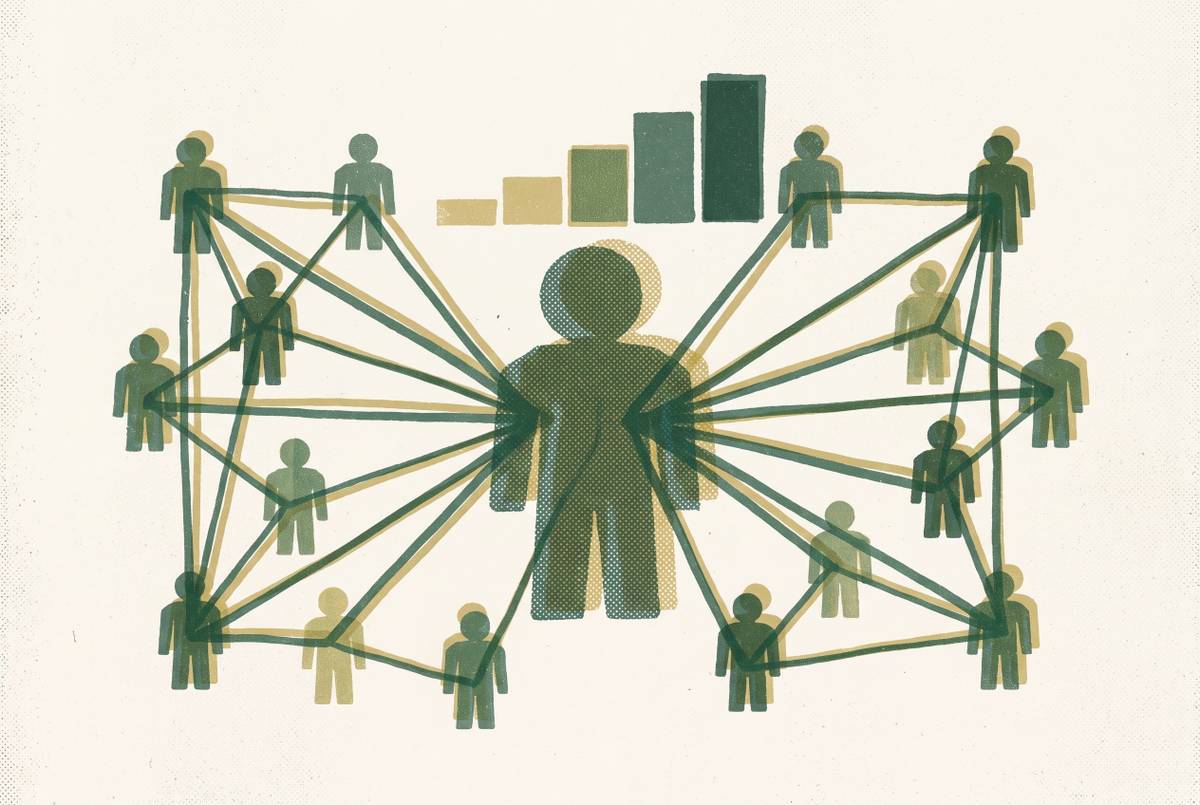
A founder's authority rarely lives in the org chart, and this is where most succession plans get the whole exercise backward: they draw a box, put a name in it, and call the job done. Authority lives in three places that resist documentation entirely, and no successor inherits any of them just because the announcement says they now hold the title.
The first is relational capital. Clients who know the founder by name, lenders and suppliers who extended trust to a person rather than to a company, key hires who joined specifically because of who was doing the recruiting. None of that sits in a file anywhere.
The second is informal authority. Staff defer to a founder because that founder earned credibility over years of decisions that turned out right, or at least defensible under pressure. A successor starts at zero on this dimension on day one, no matter how carefully the handoff is staged.
The third is institutional knowledge, encompassing the strategic rationale behind decisions made years earlier, the full arc of client history, and the cultural norms that were never written into a handbook because the founder was always in the room to explain them in person. Once that founder leaves, whatever wasn't captured is simply gone, and no amount of exit-interview goodwill retrieves it.
This carries a price tag, and it isn't hypothetical. Companies with documented succession plans achieve 20 to 40% higher valuations on exit, because reduced key-person risk is something acquirers and investors actively pay for. Founder-dependence appears in due diligence as a discount line item, not a soft concern raised in a meeting and forgotten.
The same failure mode appears earlier, at the growth stage, long before anyone is thinking about succession. Data shows average startup headcount growing from around six people at Seed to 48 at Series B. The habits that work at six people, where the founder is the final decision-maker on hiring, vendors, and everything between, break down hard at 48. That makes the jump from one funding round to the next a predictable leadership crisis, not an occasional one. The successor who fails here is rarely unqualified on paper. What's missing is the relational infrastructure that made the role work for the person who built it from scratch.
The psychological barrier that structural plans consistently underestimate
Founders often cannot cleanly separate their own identity from the company they built, and no succession template accounts for that. Letting go doesn't register as a professional handoff. It registers as something closer to an existential loss, and that distinction explains almost every stalled transition on record.
In practice, this looks like a plan that exists on paper and gets ignored in real time: the founder still sits in every critical meeting, still fields calls that were supposed to route to the successor, still weighs in on decisions formally transferred away months earlier. Read from the outside, this can look like a trust problem, or a failure to delegate properly. It's neither: it's identity, and no governance fix repairs an identity problem. It's identity, and no governance fix repairs an identity problem.
The cost to the successor is specific and immediate. A founder who lingers signals to the entire organization that the new leader's authority is conditional, which undermines the very credibility that successor is trying to build from zero. The lingering is driven by fears that recur across founders facing this exact moment, bound up in what it means to hand over something built from nothing and discover that it continues without them.
The relational complexity family business succession adds, according to the data
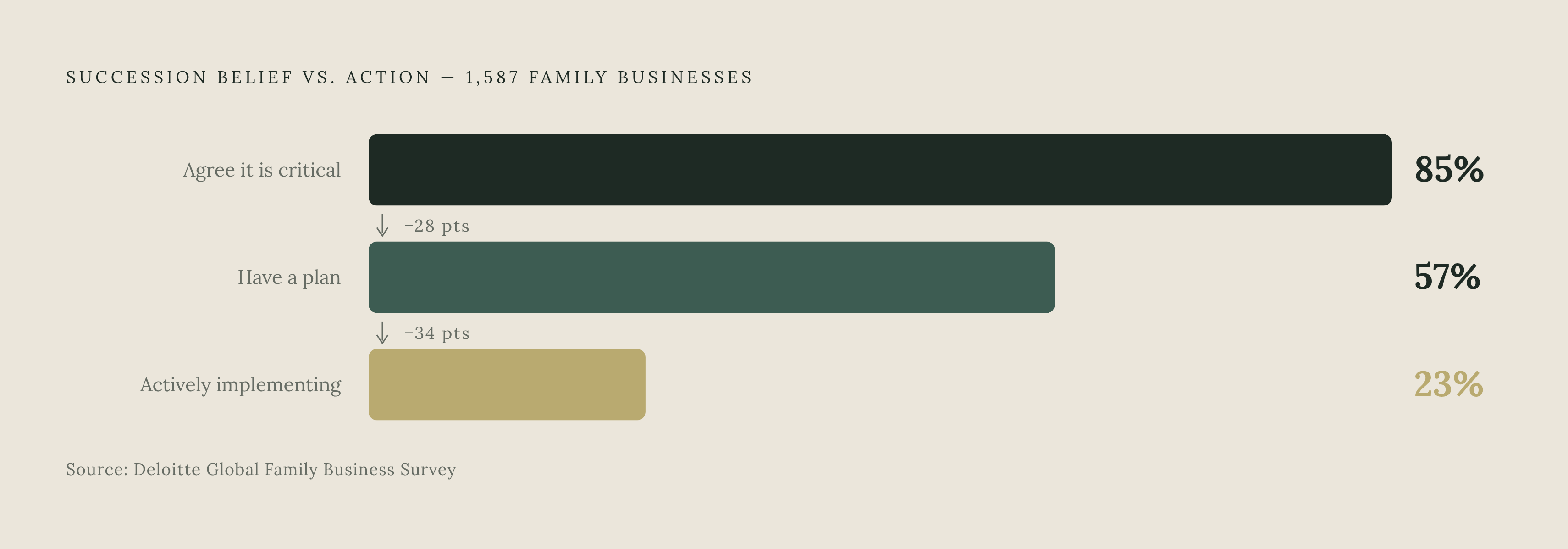
Family firms compound the identity problem with kinship layered on top of it. Deloitte's Private Family Business Succession Planning and the Next Generation report, the largest recent study of its kind, surveyed 1,587 family businesses with revenues of at least $100 million across 35 countries, backed by 30 in-depth executive interviews. These are not small operations: in 2024, the businesses in the study generated average revenue of $2.8 billion each, for a collective $4.4 trillion.
Even at that scale, with no shortage of resources or advisors on retainer, the readiness gap holds firm. 85% of family business executives agree that strategic succession planning is critical. Only 57% have actually established a plan, just 23% are actively implementing one, and 30% admit their planning is behind schedule. Agreeing that something matters and doing something about it are two separate acts, and the gap between them doesn't close just because there's more revenue in the room.
The sharpest fault line is next-generation readiness. Nearly half, 49%, of private business owners believe the next generation is only "somewhat prepared" to manage the wealth and responsibility coming to them, and 40% say they are outright unprepared. That's a family looking honestly at itself and not much liking the answer it finds.
Board behavior and governance failures in practice
Boards fall into their own version of the same avoidance, and the excuse is almost always identical: nobody wants to be the director who tells a founder it's time to go. This discomfort actively blocks long-term CEO succession planning, at companies where non-founder-led peers increasingly treat the same process as routine business.
The deeper failure is conceptual, and it's the one boards get wrong most often. Founder-led firms bundle leadership, culture, purpose, and governance into one person's particular way of operating, and each of those four things needs separate, deliberate handling once leadership changes. Boards routinely treat succession as a single personnel decision, essentially "pick the next CEO," instead of the systemic transition it actually is.
The board-preparedness numbers confirm the pattern rather than complicate it. Only 49% of boards discussed emergency CEO succession planning in the prior 12 months. 37% of directors report delaying CEO transitions specifically because no internal candidate was ready. And 24% of departing S&P 500 CEOs served less than five years. Put together, these describe boards that plan for a transition only once it's already unavoidable, not years ahead of it, which is precisely backward given how long relational capital takes to rebuild once it's lost.
The components of a succession plan that accounts for invisible assets, not just reporting lines
Structural planning is necessary. It is the floor, not the ceiling, and boards most often err by mistaking one for the other. That structural work means identifying critical roles, defining what skills each one actually requires, and building a multi-horizon succession slate instead of betting everything on one named heir. It means documenting which decisions transfer on day one, which phase in over months, and what the escalation path looks like during the messy middle of the transition. In family businesses specifically, it means separating legal, financial, and ownership structure from management succession, since the two get conflated constantly and mishandled as a result.
None of that touches the relational layer, and that's exactly where most plans quietly fail. Client relationships need deliberate, visible transfer, with the founder sponsoring the successor in front of the client directly rather than sending a letter announcing the change. The goal is transferred trust, not transferred paperwork. Staff need explicit, repeated communication about where decision authority now sits, because informal deference to the founder doesn't dissolve on a schedule. It persists until the organization actually watches the founder defer to the successor in a moment that counts, in a room, in real time. Lender, supplier, and partner relationships need mapping one at a time, sorted by which are personal to the founder and which specific transition sequence applies to each.
Then there's the knowledge layer, the hardest one to build: it requires the founder to write down things that were never written down, including the reasoning behind old strategic bets, the client history that lives only in memory, and the cultural norms that existed only because the founder was always present to model them in person. A succession plan that redraws the org chart is solving the visible ten percent of the problem. The other ninety percent was never on paper to begin with, and no amount of structural planning finds it after the founder has already walked out the door for good.
Sources
- Succession Planning: Why It Must Be a 2025 Priority
- Why Succession Planning Must Top Advisors
- 20 Key Business Owner Statistics on Exits & Succession
- 78% of Family Business Owners Expect to Hand Over the CEO Seat. 23% Think Anyone Is Ready. - The Lonely Entrepreneur
- Succession uncertainty and growth demands define 2025 for private business owners
- Succession Planning for Business Owners Guide 2025
- deloitte.com