Retention Risk Scoring for High-Dependency Employees
Standard flight-risk models miss which departures would actually break your business.

Retention risk scoring measures who's likely to leave, not what it would cost the organization if they did. For one specific population of workers, the Keyholders and specialists whose exit would actually break something, that gap is the whole design flaw. It's the whole design flaw, and most retention programs never notice because they're scoring the wrong axis.
Mercer's US Turnover Survey found average voluntary turnover fell to 13.0% for 2024-2025, down from 17.3% in 2023. Read alone, that looks like a labor market cooling off, employees settling in, HR catching a break. Gallup's retention research says otherwise: 52% of employees report they're either watching the job market or actively looking, the highest self-reported flight risk since 2015. Fewer people are quitting, yet more people want to, and that divergence is the tell, since quit rates measure what already happened while intent-to-leave measures pressure that hasn't released yet. Standard flight-risk models, built to score the average employee in the average role, can't tell you which of those pent-up departures would actually hurt.
What makes an employee high-dependency, not just high-performing
High performance and high dependency overlap, but conflating them is where most retention programs go wrong. A strong individual contributor whose output could be redistributed across a team within a few weeks is not a single point of failure, no matter how good the work is. A mid-level specialist who happens to be the only person with a working relationship with a key regulator is exactly that, regardless of how the last performance review read. Performance reviews and dependency audits are answering two different questions, and treating them as one is a mistake.
Three distinct forms of dependency tend to appear on teams. The Keyholder holds access rights or credentials that can't be delegated, so the rest of the team is simply stuck without them. The Certified One is a matter of licensure or regulatory sign-off authority rather than knowledge at all: document every process that person follows in exhaustive detail, and it changes nothing, because you can't teach someone else the legal right to approve a filing. The Judgment Call, the hardest of the three to spot, is a person whose real value is the authority granted to them rather than any expertise held privately. Colleagues might understand the decision just as well, but they won't make it, because no one has told them they're allowed to.
The operational tells stay fairly consistent across all three types. Projects stall the moment this person takes a vacation. Emergency access requests pile up after a single sick day, and high-stakes decisions route, almost reflexively, into one inbox, even when other qualified people sit two desks away.
The consequences run well past scheduling headaches. Concentrated dependency puts a ceiling on how much the business can scale, complicates succession planning at exactly the level where succession planning matters most, and creates a retention dynamic that's genuinely unhealthy: the employee knows they're indispensable, and that knowledge changes the negotiating posture on both sides. Investors and acquirers notice, too. A visible single point of failure is a discount line item in due diligence, whether or not anyone says so directly.
The true cost of losing a high-dependency employee
Replacing a departed leader or manager costs somewhere around 200% of their salary. For technical professionals, the figure runs closer to 80%. Those numbers cover direct replacement costs, and even they understate the real exposure for a high-dependency role.
Roughly 30-40% of replacement cost is hard cost, the kind that appears on an invoice. The other 60% is soft cost that most finance models undercount, made up of productivity loss, morale damage on the team left behind, and institutional knowledge that never gets line-itemed anywhere. That knowledge is rarely abstract. It's the customer's preference for talking through problems on a Thursday call, the undocumented workaround for a system that's technically broken but works if you know the trick, the relationship dynamics that live entirely inside one person's head and nowhere else.
Take a high-dependency employee who personally maintains relationships with a meaningful share of key customer accounts. The replacement doesn't inherit that trust. The business rebuilds it month by month, carrying real and material real and material revenue risk on that book of accounts until the new relationship solidifies. It sits on the balance sheet as an exposure regardless of training and regardless of whether anyone's accounted for it.
The structure of a dependency-adjusted retention risk score
A workable score needs two layers, and conflating them is the single most common design mistake in this field.
The first layer is standard flight-risk signal, the same inputs any competent retention model already uses. Compensation position relative to market matters here: Payscale's 2026 flight risk data found that jobs with a new-hire market advantage, meaning external pay for new hires outpaces internal pay for tenured staff, average a 3.6% pay gap, and employees sitting in those roles carry structurally elevated risk before anything else even enters the picture. Tenure and promotion trajectory matter too, measured by how long since the last promotion, the last comp review, and the last title change. Engagement data feeds in as well: survey scores, pulse results, the tone of manager feedback. McLean & Company's report, covering 254,000 employees across 240 organizations, found career advancement scored only 58.3%, the second-lowest driver measured, which makes it a reliable leading indicator of someone quietly checking out. Research consistently finds that leadership quality and communication issues rank alongside pay as stated reasons for leaving. Behaviorally, a cluster of behavioral signals tends to appear before someone exits voluntarily, spanning performance changes, shifts in collaboration patterns, schedule deviations, and reduced engagement with core job tools.
None of that is new. The second layer, the dependency multiplier, is what most models never build, and it draws on signals standard attrition scoring never asks about. A knowledge concentration index captures how much undocumented, role-specific know-how lives exclusively in one person's head, proxied by documentation gaps, the frequency of "only they know" escalations, and cross-training that has actually happened rather than just been scheduled on paper. A role replaceability score estimates time-to-productivity for a replacement, adjusted for how deep the external candidate pool actually runs. A role that takes the better part of a year to backfill carries far more weight than one with twenty qualified applicants a recruiter could call tomorrow. Relationship ownership depth counts the number and criticality of external relationships, client, regulatory, partner, that belong personally to the employee rather than to the institution. Access and credential concentration flags whether someone holds the only instance of a sign-off authority, a system permission, or a vendor relationship that can't be handed off on short notice.
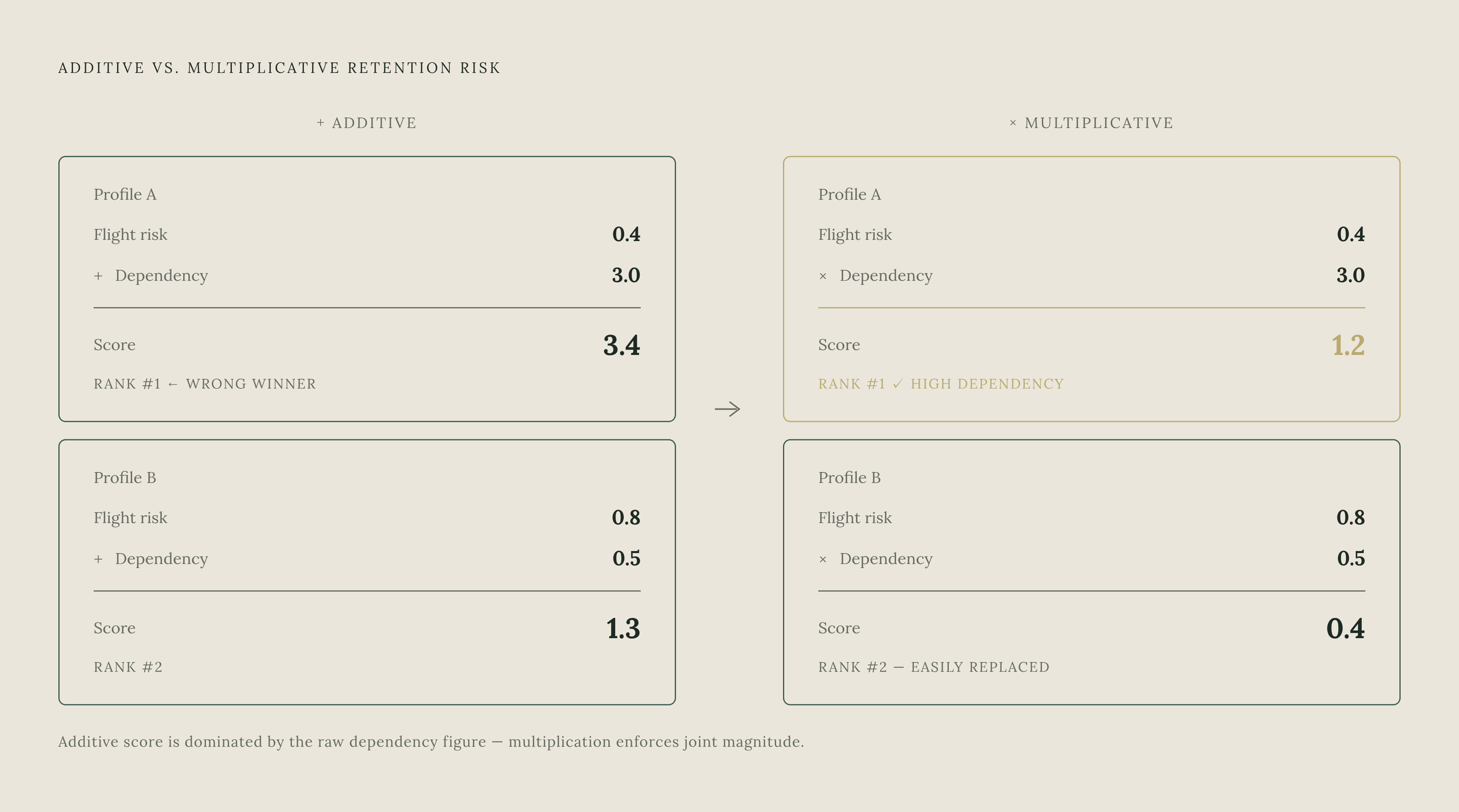
The score itself has to be multiplicative: flight-risk probability times the dependency multiplier. Adding the two layers instead is the design choice to avoid, since it quietly buries the exact people the model exists to catch. A moderately flight-risky employee with an extreme dependency profile should outrank a highly flight-risky employee whose role could be backfilled from a stack of resumes, and only a multiplicative structure forces that ranking to hold.
How machine learning and explainability make the score actionable
A study by Pavithran and Vadivel, "Explainable attrition risk scoring for managerial retention decisions in human resource analytics," published in Frontiers in Big Data (vol. 8), offers the most directly relevant academic benchmark for how this kind of scoring performs in practice. Their Random Forest classifier reached an AUC-ROC of 97.37%, the strongest result among the models they tested. Calibrating that model with the sigmoid method brought the Brier Score down from 0.03873 to 0.03480, a modest-looking shift that means something concrete: predicted probabilities line up more closely with what actually happens, which matters enormously when a score decides who gets a retention conversation this week versus next quarter.
The harder problem the study addresses is explainability. Most predictive models hand back a number with no account of what produced it, and HR practitioners, reasonably, hesitate to act on a black box, particularly in conversations where fairness and accountability already sit under scrutiny. Pavithran and Vadivel used LIME to show which factors drove any single employee's individual score, and SHAP summary plots to show which features mattered most across the model as a whole. That pairing, local explanation plus global explanation, is what turns a number into something a manager can actually use.
For high-dependency employees, that distinction isn't a nice-to-have. A manager walking into a retention conversation with someone the business genuinely can't afford to lose needs to know the driver: pay, stalled career growth, a strained relationship with their own manager, or some other cause. A score with no reason attached tells a manager that someone is at risk, but not what to do about it. In a conversation this consequential, a manager with reasons has a script. A manager without them has only a guess.
Calibrating the model for the high-dependency population
High-dependency employees make up a small slice of any workforce, often a very small one, and that creates a real technical problem. Training data dominated by the general employee population can wash out the signals distinctive to this group, simply because there aren't enough of them in the dataset to register.
Class imbalance is a well-documented issue in this kind of modeling, and Pavithran and Vadivel addressed it with SMOTE, the Synthetic Minority Oversampling Technique. The departure of a high-dependency employee is exactly the kind of event SMOTE was built for: rare in frequency, severe in consequence, and easy for a model to underweight if it's trained the same way as everything else.
Thresholds need recalibrating too, and this is where a lot of otherwise sound models fail in practice. A risk score that earns a "monitor" tag for a general employee should trigger something closer to an immediate conversation when the employee in question is a key person, because the cost of waiting isn't symmetric across the workforce. Compensation deserves specific attention here: Payscale's data found tenured employees in healthcare and R&D earning roughly 37% more than new hires in the same fields. That tenure premium is a structural advantage that quietly erodes over time if pay reviews lag the market, turning a stable retention position into a flight risk almost without anyone noticing until the resignation letter lands on a desk.
Intervention design once a high score appears
Not every elevated score calls for the same response, and treating them all the same wastes the one advantage the score was built to provide.
High flight-risk paired with high dependency needs an immediate, confidential conversation with the direct manager and a structured retention plan behind it, escalated to senior leadership given what's operationally at stake. Moderate flight-risk with high dependency calls for something less urgent but still deliberate: a career development conversation, a compensation review benchmarked against the external market, an honest look at whether workload has quietly become unsustainable. High flight-risk with low dependency is the one case where the standard HR retention playbook already works fine, without needing the dependency-adjusted machinery.
The conversation itself has to follow the explanation and the score, in that order. Gallup found that 51% of exiting employees said no manager or leader spoke with them about their job satisfaction or future with the organization in their final three months, which is less a data gap than a process failure repeating itself across an entire workforce. The score creates the occasion for a conversation that should have happened anyway, and the SHAP or LIME explanation tells the manager which topic to actually raise once in the room.
Career development is the lever organizations reach for least, despite showing up consistently as a leading reason for leaving in workforce retention research. For high-dependency employees, who are frequently deep specialists rather than generalists on a management track, that conversation is rarely about promotion. It's about lateral enrichment, broader project scope, or more external visibility, growth that doesn't require leaving the seat that makes them so hard to replace.
Every intervention for a high-dependency employee needs a second track running in parallel, aimed not at the person but at the concentration itself: documentation sprints, real cross-training instead of the token version, deliberate introductions between the employee and colleagues who could eventually share the load. If the retention effort succeeds, that work still pays off in resilience. If it fails, the exit that eventually happens is no longer a single point of failure.
Building the scoring capability inside an HR function
Most HR functions run somewhere between a spreadsheet and a full machine learning pipeline, and the dependency-adjusted approach scales down just as easily as it scales up.
At the early stage, a structured dependency audit, manually scoring knowledge concentration, replaceability, and relationship ownership, combined with manager-reported flight-risk signals, produces a usable risk register with no ML infrastructure. At the intermediate stage, existing HRIS data, compensation position, tenure, promotion history, engagement scores, feeds a logistic regression or even a simple weighted rubric, with the dependency multiplier layered on as a manual overlay a human applies on top. At the advanced end sits something closer to the Pavithran and Vadivel framework: a calibrated ensemble model with SHAP-based explanations, continuous behavioral signal feeds, and alert thresholds that fire automatically rather than waiting for a quarterly review.
None of that works without governance, and this is where most rollouts quietly fail. Any model influencing compensation, career decisions, or where management attention goes needs transparency about which signals feed it, how they're weighted, and how bias gets audited on an ongoing basis, including after launch. That matters even more given that only 1 in 3 employees strongly agree they can speak up at work without fearing consequences. Employees already skeptical of being watched will not extend the benefit of the doubt to a scoring system they can't see inside.
Purpose-built workforce analytics platforms can help here, surfacing behavioral indicators like collaboration trends, tool usage, and schedule deviations, layered against HRIS data. Prodoscore is one example, tracking productivity signals across business applications to surface flight-risk indicators without relying on manager impression alone. A platform's value depends on explaining its output at the individual level, not on producing a dashboard, since an aggregate chart tells a senior HR leader the state of the workforce and tells a manager nothing about the one person sitting across the desk from them.
The algorithm, in the end, is not where any of this starts. Someone has to first decide who actually qualifies as high-dependency, and that's a judgment call belonging to business leaders and HR together, made before any model gets built, not patched in after the fact.
Sources
- Frontiers | Explainable attrition risk scoring for managerial retention decisions in human resource analytics
- Research flags employee retention risks - REMI Network
- 7 Employee Retention Statistics To Watch in 2026 - WebMD Health Services
- pubmed.ncbi.nlm.nih.gov
- 28 Employee Retention Statistics [2026] | Paycor
- applauz.me
- qooper.io
- The Top 5 Data-driven Indicators of Employee Retention Risk