Key Person Dependency Risk in Business Continuity
When one person becomes irreplaceable, the entire organization becomes fragile and undervalued.
Key person dependency is a structural flaw, not a staffing problem. It appears when critical knowledge, relationships, or decision-making authority live inside one person's head instead of inside the organization's systems, and it makes an otherwise healthy business fragile in ways that become visible on a balance sheet once that person walks out the door.
The distinction matters because it's easy to confuse this with simply having strong performers. High performers make an organization better. Key person dependency makes it breakable, and whether an organization has one or the other is not a matter of opinion. The person at the center of it is rarely the problem. The structure that grew up around them is, and that structure can form at any level of a company. Founders and CEOs get the most attention in this conversation, but the same fragility appears around a technical expert who's the only one who understands a legacy system, a top salesperson who owns every important client call, a compliance specialist who carries regulatory nuance no one else has bothered to learn, or an operations coordinator whose informal authority never made it onto an org chart.
How dependency builds silently through everyday decisions
Dependency almost never comes from negligence. It builds through a series of individually reasonable choices that, added together, pile too much weight onto one person.
A capable employee volunteers to take on extra responsibility because they're good at it and it feels efficient in the moment. Managers, under deadline pressure, route the hard problem to whoever has reliably solved it before. Colleagues learn that one person gives fast, accurate answers, so they stop asking anyone else. Documentation keeps getting pushed to next quarter because it's faster for the expert to just handle the task than to write down how. None of these decisions look wrong when they're made. Over months and years, though, they stack into one person becoming the default owner of processes, client relationships, and decisions nobody ever formally assigned to them.
The warning signs tend to appear before anyone names the problem out loud. One employee gets copied on every important email because no one else has the context to be left off. Decisions stall the moment that person travels. Onboarding a new hire requires scheduling time with that specific employee, since the information doesn't live anywhere else. Core processes exist only as tribal memory, passed along in hallway conversations rather than written down. A single person owns every meaningful vendor or client relationship, with no one positioned as backup.
Annual leave, oddly enough, works as a fairly reliable diagnostic here. If operations wobble every single time a particular person takes a week off, that is evidence of a structural problem the business has been carrying quietly for a while. It's evidence of a structural problem the business has been carrying quietly for a while.
What is at risk when a key person becomes unavailable
The immediate cost is operational, and it appears fast. Productivity drops, response times to clients slow, decisions that used to take an hour now sit unresolved for days. In acute cases, the disruption becomes measurable within 48 hours of the person's absence.
The deeper cost is knowledge loss, and it's structural, not a minor inconvenience. Tacit knowledge, the unwritten expertise that lives in people's heads rather than in any manual or system, makes up most of what an organization actually knows. When that person leaves, the knowledge leaves with them unless someone has deliberately pulled it out beforehand. Institutional knowledge loss consistently ranks among the top concerns organizations cite around offboarding.
Replacing that person costs more than the knowledge loss alone. Recruiting and onboarding a replacement for high-level talent can run 150% to 400% of the departing employee's salary, and projects tied to that role can slip six to twelve months while the new hire climbs a learning curve the old one never bothered to write down.
There's also a ceiling effect easy to miss until growth actually stalls against it. When one person is the bottleneck for every new client, every new initiative, every expansion decision, the business's growth rate becomes a function of that person's bandwidth, not of market demand or capital or team size.
How dependency discounts business value and blocks transactions
Buyers price this risk in, and they price it in hard. Valuation practitioners have put the typical key person discount at 10% to 25%, though appraisers retain real discretion in landing on a specific figure for a specific deal. In severe cases, where one individual holds nearly all the client relationships and technical know-how, discounts reach 20% to 50% of the business's value.
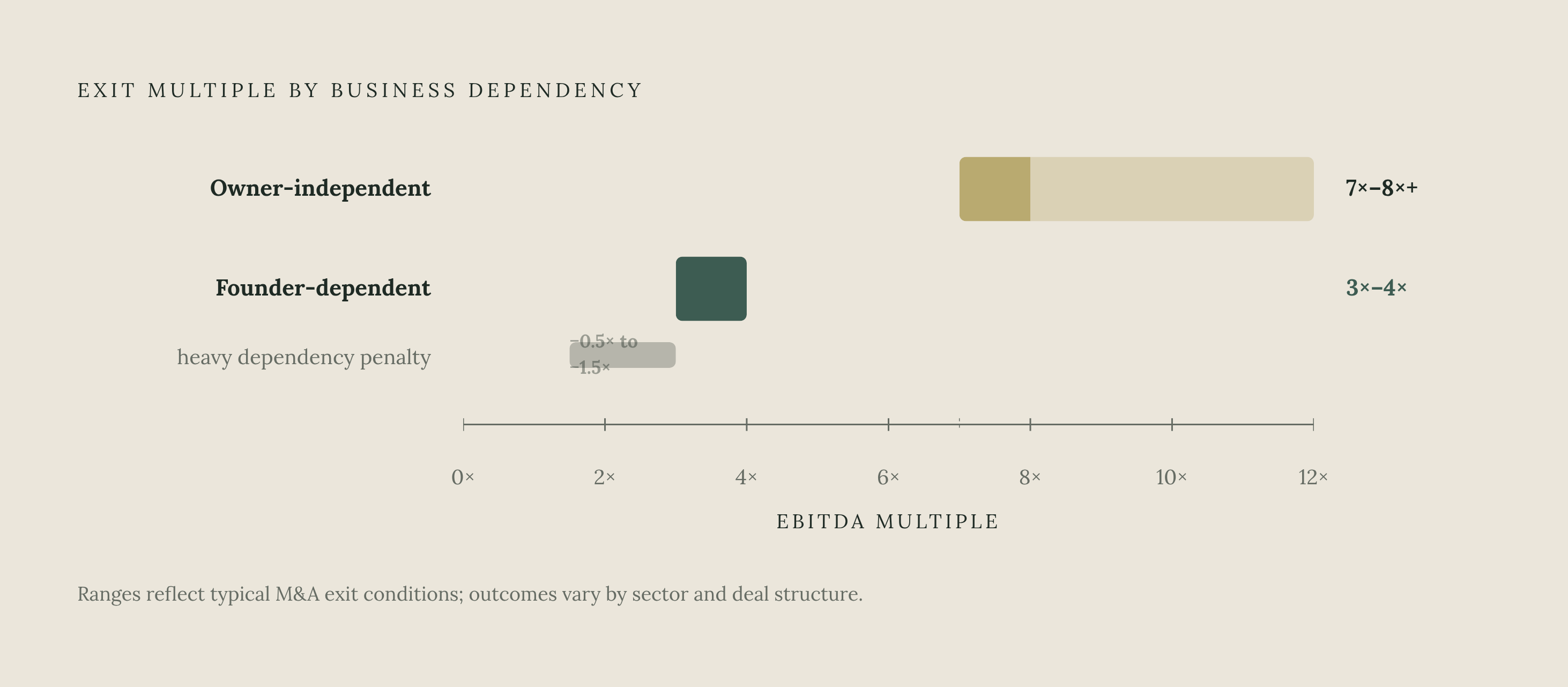
FISART's analysis of closed transactions across thirteen service industries found owner-dependent businesses selling at a 1.0x to 2.0x EBITDA discount against peers with a functioning management layer. The gap widens further at the high end of the market: research across M&A transactions shows founder-dependent companies exiting at 3x to 4x EBITDA, while owner-independent businesses command 7x or 8x and up. That gap isn't a rounding error. It often separates a founder's full retirement plan from a fraction of it.
Dependency reshapes deal structure as much as price. Buyers frequently require the seller to stay on for one to three years under an earnout arrangement, which dilutes the real value the seller walks away with, since much of the payout hinges on performance the seller no longer fully controls. Heavy dependency also triggers longer transition periods, larger escrow accounts, specific indemnities, and retention packages built solely to keep key non-owner staff from leaving after close, and significant dependency can reduce a multiple by a further 0.5x to 1.5x.
In the worst cases, no deal happens. The Precision Firm, a manufacturing M&A advisory, calls owner dependency the number one deal killer in industrial M&A. Only 20% to 30% of businesses brought to market actually sell, and a lack of preparation around owner-held responsibilities is the thread running through most of the ones that don't.
Why succession planning alone is not a sufficient response
Most organizations file this under succession planning and consider the box checked. That's a misdiagnosis, and it's the one that costs the most later. Key person dependency is a knowledge architecture problem at its core, and succession planning by itself doesn't touch it.
The succession numbers tell an uncomfortable story on their own: only 21% of HR professionals report having a formal succession plan in place, while 56% say their organization has none. Even where a plan exists, it typically answers one question, who replaces whom, and stops there. It rarely spells out what specific knowledge, client relationships, and decision authority actually need to transfer, or how that transfer happens in practice, step by step, before someone's already out the door.
Succession planning, as most companies practice it, addresses the leadership layer. Key person dependency, though, usually lives well below that layer, in operational, technical, and client-facing roles that never make it onto an org chart's succession slide.
Documentation: making implicit knowledge explicit and accessible
Tacit knowledge, expertise never written down because the expert never needed it written down, makes up most of what an organization actually knows. It doesn't exist in any system until someone sits down and deliberately pulls it out.
Start with triage. Identify which processes, systems, contacts, and decisions currently depend on one person, then rank them by how much operational or customer damage would follow if that person vanished tomorrow. Not everything needs documenting at once. The highest-impact dependencies do, and the rest can wait.
Good documentation covers more than step-by-step process guides, though those matter too. It captures decision frameworks: what criteria does this person actually use when making a judgment call, and at what point do they escalate rather than decide alone? It includes contact records with real context, not just a name and a phone number, but why the relationship matters and what history sits behind it. It covers system access and configuration details that live only in one person's memory, and it explains how routine and complex problems typically get resolved, including the workarounds nobody ever put in writing.
None of this is a one-time project. Documentation that goes stale creates almost as much confusion as no documentation at all, so it needs a scheduled review cycle built in from the start, not bolted on as an afterthought once someone notices the file hasn't been touched in a year.
Cross-training and shared ownership as operational resilience
Cross-training means spreading operational capability across more than one person, deliberately and continuously, so no single absence, planned or otherwise, becomes a single point of failure. It only works if it's treated as ongoing practice.
In practice, that takes a few concrete forms. Job shadowing puts less experienced employees alongside subject-matter experts on real, live tasks, not simulations. Shared account ownership means two people carry the same client relationship at once, with a defined handoff protocol so the client never notices a gap. Structured handovers formalize the transition of responsibility ahead of any planned absence, rather than leaving it to a rushed conversation on someone's last day. Bringing colleagues into specialist projects embeds the knowledge transfer directly into real work, instead of relying on a training session that fades from memory within weeks.
Framed this way, cross-training stops looking like risk mitigation and starts looking like a development investment. Less experienced staff gain real skills and a path forward in their careers. The experts build mentoring and leadership capability they wouldn't otherwise get credit for. The organization gains bench strength without adding a single position to headcount.
The employees who carry the most organizational weight are often the ones least able to step away from it, because no one else can pick up what they're holding. Cross-training is how organizations actually relieve that pressure, rather than quietly burning out the very people they depend on most.
Succession planning as a structured, ongoing process rather than an emergency response
Succession planning, properly understood here, means more than naming an heir apparent for the corner office. It means building a bench at every role where dependency has taken root, including the ones nowhere near the top of the chart.
A succession plan that actually functions answers a specific set of questions. Who could step into each critical role, and how ready are they today versus twelve months from now? What development does each candidate genuinely need, as opposed to simply being designated as the successor on paper? How will client relationships, institutional knowledge, and decision-making authority actually transfer, step by step, and who owns each part of that timeline?
The twelve-to-24-month horizon that keeps appearing in this kind of planning isn't an arbitrary number pulled for effect. Getting the foundational work underway, documentation, knowledge transfer, building real bench strength, takes roughly that long when it's done properly, rather than as a rushed handoff crammed into someone's notice period. Organizations that only start this process once a departure has already been announced are, structurally, already behind, and no amount of urgency afterward buys back the time.
M&A buyers look for a functioning second-tier management team that proves the business runs without its founder or owner standing in the room. Building that team isn't separate from succession planning, it's succession planning in its most commercially legible form, the version a buyer can actually see and price into an offer.
Financial protection tools that buy time while structural fixes are built
Key person insurance pays the company, not the family, a lump sum when a named individual dies or becomes disabled, and that distinction is what makes it a business continuity tool rather than a life insurance product with a corporate name attached. The payout doesn't fix the underlying dependency. It buys the runway to survive the disruption while a replacement gets found, trained, and brought up to speed on relationships nobody wrote down.
That's the limit of what insurance can do. A check covers the cost of recruiting, the revenue gap during the search, maybe the retention bonuses needed to keep the rest of the team from bolting in the chaos. It does not transfer the knowledge sitting in the departed person's head, because no policy has ever been underwritten against tribal memory. Insurance buys time. Documentation, cross-training, and a real succession plan are what fill that time with something other than panic.